
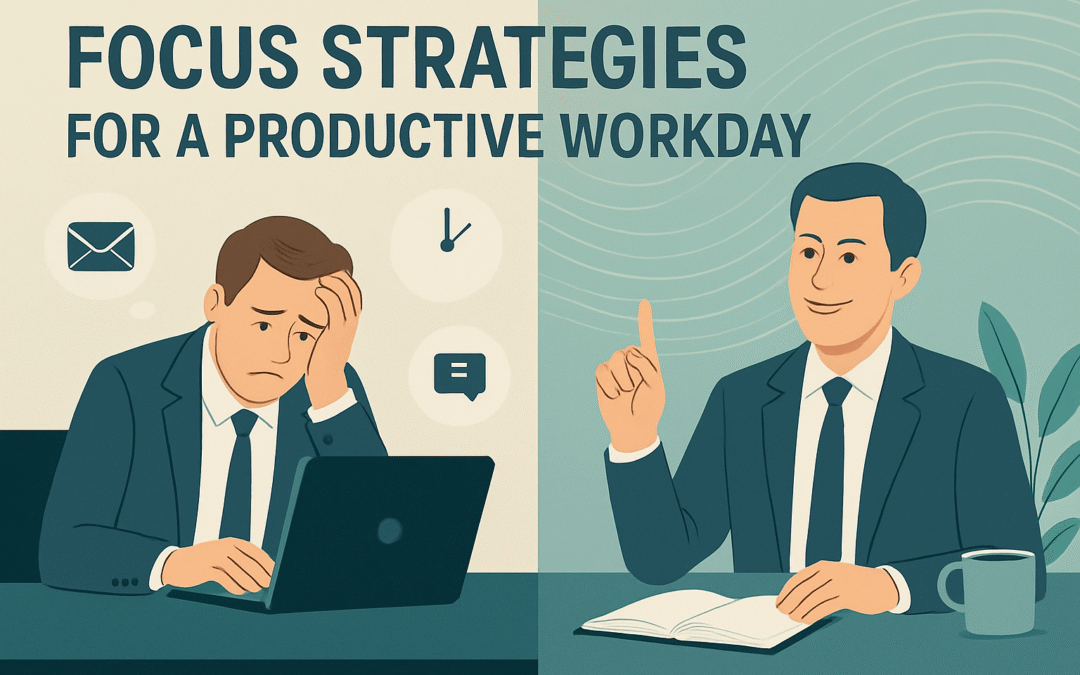
Looking to supercharge your productivity? You’re not alone. In today’s fast-paced world, finding reliable focus strategies for a productive workday can make all the difference between feeling overwhelmed and achieving your goals with clarity and confidence. The good news: research-backed methods exist that can help anyone—from busy professionals to entrepreneurs—get more done with less stress. In this post, we’ll dive deep into the top three focus strategies proven to transform your workday: time blocking, eliminating distractions, and setting clear goals.
Time Blocking: The Foundation of Focused Productivity
Bonus Insight: Time Blocking vs. Task Batching
You may have heard of both time blocking and task batching as productivity strategies—but they’re not quite the same. While time blocking assigns specific blocks of time to a variety of tasks across your calendar, task batching focuses on grouping similar tasks together to complete them in a dedicated session.
For example, you might block out 9–11 a.m. for deep work (time blocking), but within that block, choose to write two blog posts back-to-back (task batching). Batching works well for repetitive or mentally similar tasks like replying to emails, recording videos, or administrative work.
Key differences:
- Time blocking = managing your day hour-by-hour to protect time for focus
- Task batching = reducing cognitive switching by grouping similar tasks
Many professionals find success by combining both: block your time, and within those blocks, batch tasks that require a similar mindset. This reduces mental fatigue and sharpens your focus even further.
Eliminate Distractions: Creating a Focus-Friendly Environment
Time blocking is a powerful time management technique that involves dividing your day into dedicated blocks of time, each assigned to a specific task or group of related tasks. Instead of reacting to whatever comes your way, you proactively schedule your priorities, giving your brain the structure it needs to focus deeply and perform at its best.
How Time Blocking Works
- Start by listing your key tasks for the day.
- Assign each task to a specific time slot in your calendar.
- Treat these blocks as appointments—non-negotiable and protected from interruptions.
- Include breaks and buffer times to recharge and handle unexpected issues.
Why Time Blocking Improves Focus
Research in neuroscience shows that our brains are wired to focus deeply for about 90–120 minutes before needing a break. Time blocking capitalizes on this natural rhythm, allowing you to enter a “deep work” state—where you’re fully immersed in a cognitively demanding task, free from distractions. This state, popularized by Cal Newport, is where your best, most creative work happens.
Time blocking also combats decision fatigue, the mental exhaustion that comes from making too many choices throughout the day. By scheduling your tasks in advance, you eliminate the constant need to decide what to do next, preserving your mental energy for what matters most.
Benefits of Time Blocking
- Improved focus and productivity by avoiding multitasking
- Better prioritization of critical tasks
- Reduced stress and increased sense of control
- Greater accountability and motivation to complete tasks
Sample Time Blocking Routine
| Time | Task |
|---|---|
| 8:00–9:30am | Deep work: Project A |
| 9:30–9:45am | Break |
| 9:45–11:00am | Deep work: Project B |
| 11:00–11:30am | Email and admin tasks |
| 11:30–12:30pm | Meetings or collaboration |
| 12:30–1:30pm | Lunch break |
| 1:30–3:00pm | Deep work: Writing/Analysis |
| 3:00–3:15pm | Break |
| 3:15–4:30pm | Planning and wrap-up |
By following a routine like this, you create a predictable structure that trains your mind to focus when it’s time to work and relax when it’s time for a break.
Want to go deeper into managing your time and workload? Read Workplace Stress and Time Management: How to Regain Control for practical strategies.
Eliminate Distractions: Creating a Focus-Friendly Environment
Distractions are productivity’s greatest enemy. Whether digital, environmental, or mental, they can derail your focus and waste valuable time. Studies confirm that digital distractions alone can reduce productivity by up to 63%. Fortunately, you can take practical steps to reclaim your attention. For even more practical ways to stay focused, check out this research-backed guide to boosting productivity from Profit.co.
Digital Distractions
- Turn off non-essential notifications on your phone and computer.
- Use website and app blockers like Freedom, Forest, or built-in tools such as Apple’s Focus Mode and Android’s Digital Wellbeing to limit access to distracting sites during work hours.
- Schedule specific times to check email and social media, rather than reacting to every ping.
Environmental Distractions
- Declutter your workspace to minimize visual distractions.
- Use noise-cancelling headphones or play focus-enhancing background music to block out ambient noise.
- Set clear boundaries with colleagues or housemates—use a “do not disturb” sign or communicate your focus hours.
Mental Distractions
- Practice mindfulness or deep breathing exercises before starting a new time block to clear your mind.
- Keep a notepad nearby to jot down intrusive thoughts or to-do items that pop up, so you can address them later without breaking your flow.
- Take regular breaks to reset your attention and avoid cognitive overload.
Real-Life Example: Digital Detox
Try a daily digital detox hour—perhaps the first hour of your morning or the last before bed. Use this time to plan, reflect, or simply recharge without screens. Even small digital breaks have been shown to boost energy and focus.

Set Clear Goals: The Power of Clarity and Intention
Without clear goals, productivity efforts can feel scattered and unsatisfying. Goal-setting provides a roadmap, a sense of purpose, and measurable milestones that keep you moving forward. The most effective goals are those that follow the SMART framework: Specific, Measurable, Achievable, Realistic, and Time-bound.
Why Goal-Setting Works
- Clarifies what’s most important, helping you prioritize tasks
- Reduces ambiguity and decision fatigue
- Provides motivation and a sense of accomplishment as you check off milestones
- Enhances accountability, making it more likely you’ll follow through
How to Set Effective Goals
- At the start of each day, identify your top three priorities.
- Write them down in SMART format. For example: “Draft and send the Q2 report by 3pm today.”
- Break larger goals into smaller, actionable steps.
- Review your progress at the end of the day and adjust as needed.
Sample Daily Goal-Setting Routine
- Before starting work, spend five minutes listing your top three priorities.
- For each, ensure it’s specific and measurable (e.g., “Complete client proposal draft” vs. “Work on proposals”).
- Block time for each priority in your schedule.
- Check off each goal as you complete it, and reflect on what worked well.
Research Insight
A Forbes Coaches Council article notes, “Without clear goals, our potential for productivity remains untapped… Align your goals with your passions and aspirations to fuel your motivation and drive.” Regular check-ins and feedback further enhance performance and engagement.
Conclusion: Start Your Focus Journey Today
The most productive workdays don’t happen by accident—they’re built on intentional focus strategies. By embracing time blocking, eliminating distractions, and setting clear goals, you create an environment where deep, meaningful work can flourish. Each of these strategies is grounded in research and can be tailored to fit your unique needs and work style.
Why not try one of these focus strategies for a productive workday today? Start small: block out your next hour, silence your notifications, or write down your top three goals. You’ll be amazed at how much more you can accomplish with a little structure and intention.
Have questions about implementing these strategies in your own routine? Want more practical examples or tools? Let me know—I’m here to help you achieve your most productive workday yet.